


Study Planning
Last Updated : 26 August 2026 10:55-
![BINUS @Greater Jakarta]() BINUS @Greater Jakarta
BINUS @Greater Jakarta
-
![BINUS @Bandung]() BINUS @Bandung
BINUS @Bandung
-
![BINUS @Malang]() BINUS @Malang
BINUS @Malang
-
![BINUS @Semarang]() BINUS @Semarang
BINUS @Semarang
-
![BINUS @Medan]() BINUS @Medan
BINUS @Medan
-
![BINUS @Bekasi]() BINUS @Bekasi
BINUS @Bekasi
-
![BINUS @Senayan]() BINUS @Senayan
BINUS @Senayan







- ASO School of Engineering
- International Undergraduate
- Online Undergraduate
- Undergraduate
- Undergraduate (Bandung)
- Undergraduate (Malang)
- Undergraduate (Medan)
- Undergraduate (Semarang)
What Is Study Planning?
Study planning is an activity carried out by students to develop an academic plan for each semester, such as determining the target number of Semester Credit Units (SKS) to be registered and the Grade Point Average (GPA) they aim to achieve.
Why Is Study Planning Important?
Study planning should be conducted before entering a new semester. This is important because students are expected to achieve specific academic targets according to the curriculum in each semester. If a study target is not achieved, such as having to retake a course due to not meeting the minimum grade requirement, study planning can help students reorganize their academic goals.
The following are some benefits of creating a study plan:
- Motivates and directs students’ efforts toward achieving their academic goals each semester, enabling them to graduate within the designated timeframe.
- Helps students monitor their study progress independently and regularly to ensure they meet the academic performance evaluation criteria each semester. If certain academic targets are not met, students can immediately develop a new study plan to catch up in the following semester.
- Assists students in setting priorities and managing their time effectively. By knowing their current GPA and cumulative SKS, as well as setting GPA and SKS targets for future semesters, students can better organize their academic activities (assignments, self-study, class schedules, examinations) and non-academic activities (student organizations, committees, and other engagements).
What Should Be Considered When Creating a Study Plan?
When developing a study plan, students should pay attention to the following aspects:
1. Semester Study Result Report (LHSS)
- The Semester Study Result Report (Laporan Hasil Studi Semester or LHSS) provides a comprehensive overview of all grades obtained in each semester. How to Access: Instructions for accessing the LHSS can be found here: Panduan Akses Laporan Hasil Studi Semester (LHSS).
- Benefits, by downloading the LHSS, students can identify the Grade Point Average (GPA) and SKS achievements for each semester, including completed and pending academic requirements.
2. Types of Courses in the Study Program Curriculum
(The curriculum can be accessed at: https://curriculum.binus.ac.id/)
The types of courses include:
- Core Courses: Courses that reflect the specific learning outcomes and competencies of each study program.
- General Courses: Courses intended to develop students’ personal and civic character.
- Specialization Courses: Courses designed to deepen knowledge in a specific area within the study program.
- Elective Courses: Courses from the same or different study programs that students may choose according to their interests and applicable regulations.
- Minor Program Courses: Enrichment courses that provide interdisciplinary knowledge and skills, not necessarily within the same Faculty or School.
- Enrichment Program Courses: Courses aligned with the selected Enrichment Program track, covering aspects of experience, technical skills, and soft skills.
3. Minimum Academic Performance Requirements for Semester Evaluation
Students are expected to meet the following minimum requirements:
- Minimum GPA: 2.00
- Minimum Additional SKS: 15 SKS per semester
- Student Activity Transcript (SAT): Minimum of 120 points (required for Thesis Defense eligibility)
- Community Service Hours: Minimum of 30 hours (required for Thesis Defense eligibility)
How to Create a Study Plan
Students may follow these steps when creating a study plan:
- Prepare the Semester Study Result Report (LHSS) and the curriculum of the relevant study program.
- Prepare a medium for planning, such as paper, a notebook, writing tools, or digital devices (smartphones, tablets, etc.).
- List all courses that have not yet been completed, including the number of SKS, minimum passing grade requirements, and whether the courses are offered in odd or even semesters according to the curriculum.
- Map all incomplete courses based on whether they are offered in odd or even semesters. Students may register for a maximum of 22 SKS per semester. If they wish to take courses alongside an Enrichment Program, they may register for a maximum of 4 additional SKS, provided that the courses do not have scheduling conflicts or restricted components.
Sample Study Plan
A student from the B2026 Marketing Communication Program wishes to create a study plan from Semester 5 to Semester 8 in order to graduate on time. The student failed one course, Statistics, in Semester 2 and is required to retake it.
Before planning, the student should review the B2026 Marketing Communication curriculum as follows:
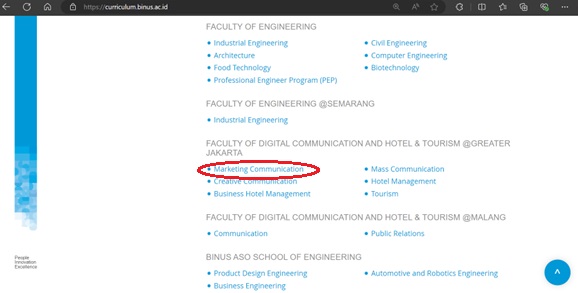
- Visit https://curriculum.binus.ac.id and select Marketing Communication.
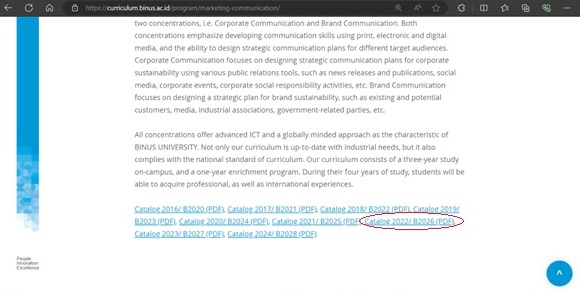
- Select Catalog 2022/B2026 (PDF).
- Review the Catalog Structure section to understand the distribution of courses from Semester 1 to Semester 8.
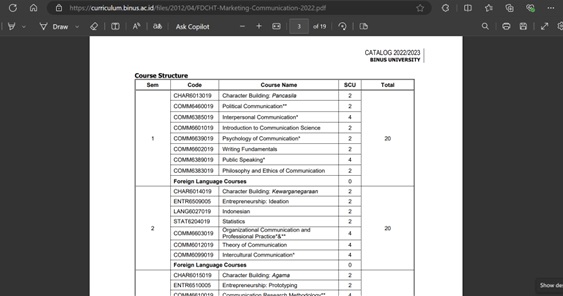
Based on the curriculum, the study plan is as follows:
Semester 5
Target Semester GPA (SGPA): Minimum 3.5
Total: 20 SKS
- COMM6634019 Environmental Issues and Brand Activism (4 SKS, minimum grade D)
- COMM6635019 Integrated Marketing Communication (2 SKS, minimum grade D)
- COMM6636019 Media Planning and Buying (2 SKS, minimum grade D)
- COMM6608019 Brand Sustainability Strategy (4 SKS, minimum grade C)
- COMM6637019 Brand Activation (2/2 SKS, minimum grade D)
- COMM6638019 Social Media Planning & Engagement (2/2 SKS, minimum grade D)
Semester 6
Target SGPA: Minimum 3.5
Total: 22 SKS
- Enrichment Program I (20 SKS)
- STAT6204019 Statistics (2 SKS, minimum grade D)
Semester 7
Target SGPA: Minimum 3.5
Total: 20 SKS
- Enrichment Program II (20 SKS)
Semester 8
Target SGPA: Minimum 3.5
Total: 6 SKS
- COMM6597019 Thesis (6 SKS, minimum grade C)
What If Students Have Difficulty Creating a Study Plan?
If students encounter difficulties in creating a study plan, they may consult with their Academic Advisor (AA) or Academic Advisory Lecturer. Students typically meet with their Academic Advisor two to three times per semester based on mutual agreement. During these meetings, students can discuss their study plans, learning strategies, GPA calculations, specialization course selection, Enrichment Program track selection, and other academic concerns.
In addition, students may seek assistance from a Student Advisory Counselor at their respective campus. Student Advisory staff can help students develop study plans and discuss academic challenges they face throughout their studies. Through study planning consultations, students are expected to gain clearer direction and better preparation for each semester.
What Is the Procedure for Study Planning Consultation?
1. Consultation with an Academic Advisor (AA)
Students may contact their Academic Advisor through various channels, including:
- BINUSMAYA messaging
- Visiting the department or study program office directly
- Communication channels agreed upon in advance, such as WhatsApp Groups or LINE Groups
2. Consultation with Student Advisory
Students may visit the Student Advisory office on their respective campus or contact the relevant Student Advisory team through: https://linktr.ee/SASC_BinusUniv (Please select the Student Advisory office corresponding to your campus area.)
Operating Hours:
Monday to Friday
09:00 AM – 04:00 PM (WIB)
Break Time:
12:00 PM – 01:00 PM (WIB)