


What to Consider Before Applying for a Program/Study Program Change?
Last Updated : 29 June 2026 12:09-
![BINUS @Greater Jakarta]() BINUS @Greater Jakarta
BINUS @Greater Jakarta
-
![BINUS @Bandung]() BINUS @Bandung
BINUS @Bandung
-
![BINUS @Malang]() BINUS @Malang
BINUS @Malang
-
![BINUS @Semarang]() BINUS @Semarang
BINUS @Semarang
-
![BINUS @Medan]() BINUS @Medan
BINUS @Medan
-
![BINUS @Bekasi]() BINUS @Bekasi
BINUS @Bekasi
-
![BINUS @Senayan]() BINUS @Senayan
BINUS @Senayan







- International Undergraduate
- Undergraduate
- Undergraduate (Bandung)
- Undergraduate (Malang)
- Undergraduate (Medan)
- Undergraduate (Semarang)
Applying for a program or major transfer is a process available to BINUS University students who wish to move to a different field of study. This decision not only affects your current academic journey but also has implications for your study duration and future career plans. Therefore, it is important to understand the differences, submission timelines, and required procedures before making a decision.
Differences Between Program Transfer and Major Transfer
Program Transfer
A program transfer occurs when a student moves to another major within the same school or faculty.
Since the transfer remains within the same academic scope:
- Students do not receive a new student ID (NIM)
- There is no need to restart from the beginning
- Some foundational courses can still be credited
Major Transfer
A major transfer takes place when a student moves to a program in a different faculty. The consequences include:
- Receiving a new student ID (NIM)
- Restarting from Semester 1
This is due to significant differences in curriculum between faculties.
Submission Timeline Requirements
- Applications can be submitted from Semester 2 to Semester 6
- The deadline is 1 month before the start of the semester
- The application can only be made once during the entire study period
Since this opportunity is limited to one time only, students are strongly encouraged to carefully consider their decision before applying.
Why Semester 1 Students Are Restricted
First-semester students are still in the adaptation phase from high school to university. During this period, they are:
- Learning the academic system
- Understanding the curriculum
- Adjusting to a new environment
Therefore, students are advised to allow sufficient time to fully understand their current major before making a significant decision.
Recommended Parties to Consult
Before deciding to transfer, students are encouraged to seek different perspectives by consulting with:
- Parents/guardians, for long-term considerations
- Academic Advisors, for academic insights
- Head or Secretary of Program, for major-specific understanding
- Freshmen Partners, for peer experiences
- Student Advisory Counselors, for professional guidance
Students may also explore program details via https://curriculum.binus.ac.id/
Application Mechanism via Student Advisory
Applications are processed through Student Advisory at each campus. Locations can be found at:
https://linktr.ee/studentadvisorybinus
The process includes:
- Initial consultation with a counselor
- The counselor will help:
- Understand the student’s reasons for transferring
- Provide considerations
- Explain the application steps
This ensures that students make informed decisions rather than impulsive ones.
Key Aspects to Consider Carefully
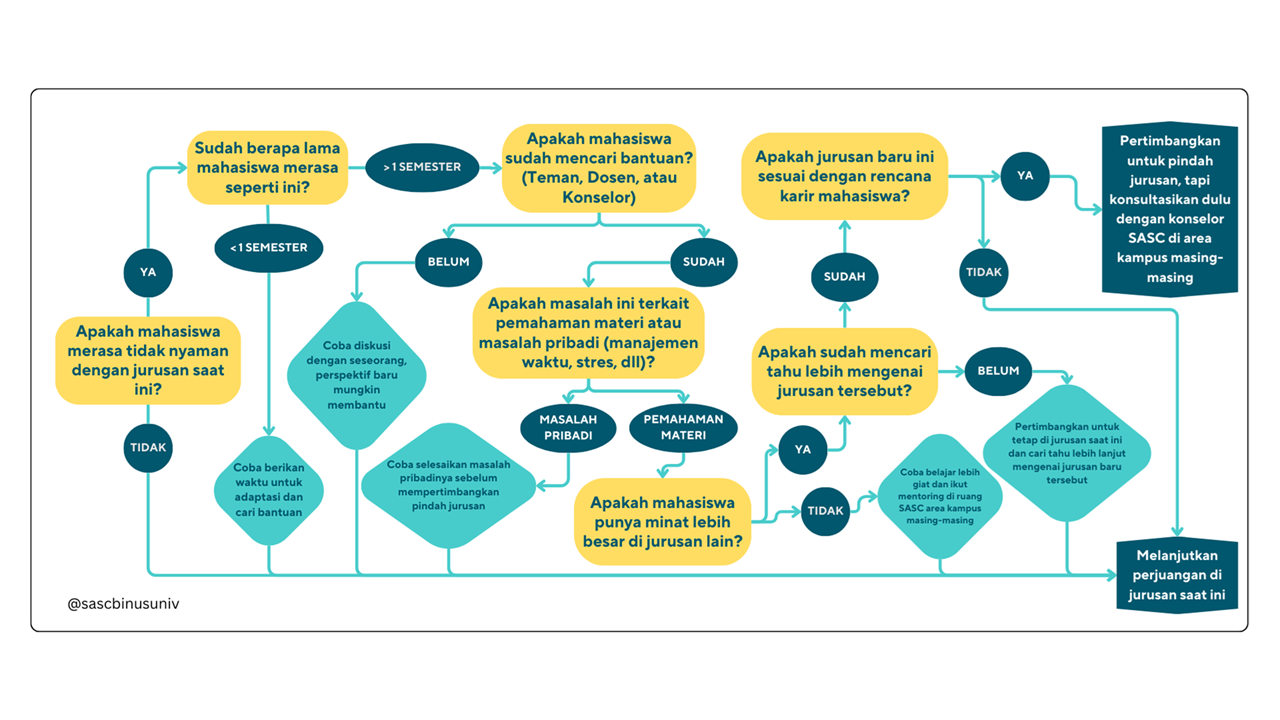
Before deciding to transfer, reflect on the following questions:
- Do you currently feel uncomfortable with your major?
- If less than 1 semester, allow more adaptation time.
- If around 1 semester, begin considering more seriously.
- Have you sought help?
Discussing with others can provide new perspectives and objectivity. - What is the source of your discomfort?
- If personal issues, address them first with counselor support.
- If academic difficulties, evaluate your interest further.
- Do you have a stronger interest in another major?
Ensure it aligns with your abilities and readiness to learn. - Have you researched the target major?
Make sure you understand:- The curriculum
- Academic challenges
- Career prospects
Answering these questions will help you make a more rational and well-directed decision.
Simplified Decision-Making Flow
This reflection process helps students determine whether they should:
- Proceed with a transfer, or
- Continue in their current major
Application Process for Program/Major Transfer
Once you are confident in your decision, follow these steps:
- Consultation & Financial Check
Consult with a counselor while your financial status is reviewed. Any outstanding payments must be settled first. - Document Preparation
Students must prepare:- Essay: Describing current academic conditions, challenges faced, reasons for choosing the new major, and commitment, concrete efforts, and academic goals in the new program
- Application Letter: Addressed to the Head of Program, including:
- Intended transfer period
- Current and target programs
- Campus location of the target program
- Contact information
- A brief explanation of reasons and academic commitment
- Counselor Review
Submit the essay and application letter to the counselor for review. Revisions may be required before proceeding. - Approval from Current Program
The application must receive approval from the current program. - Submission to BINUS Support
The counselor will forward the application to BINUS Support for further processing. - Selection Process by Target Program
Students will receive an email detailing required selection stages until a final decision is made.
- Result Announcement
Final results (accepted or rejected) will be communicated via email.
Processing Duration
The entire transfer process typically takes approximately 1–2 months.
For more details, refer to the article: Cara Mengajukan Permohonan Pindah Program/Program Studi
Conclusion
Deciding to transfer programs or majors is not merely about temporary discomfort, but about alignment with your interests, abilities, and long-term career goals.
Make sure that you:
- Fully understand your reasons for transferring
- Have explored possible solutions beforehand
- Have thoroughly researched the target program
By doing so, you can make a well-informed decision that supports your academic journey and future success.