

BINUS GRADUATE ATTRIBUTES (BGA)
Last Updated : 02 December 2025 12:01-
![BINUS @Greater Jakarta]() BINUS @Greater Jakarta
BINUS @Greater Jakarta
-
![BINUS @Bandung]() BINUS @Bandung
BINUS @Bandung
-
![BINUS @Malang]() BINUS @Malang
BINUS @Malang
-
![BINUS @Semarang]() BINUS @Semarang
BINUS @Semarang
-
![BINUS @Bekasi]() BINUS @Bekasi
BINUS @Bekasi
-
![BINUS @Senayan]() BINUS @Senayan
BINUS @Senayan






- ASO School of Engineering
- Binus Business School
- International Undergraduate
- Online Collaboration S1
- Online Master
- Online Undergraduate
- Regular Collaboration S1
- Undergraduate
- Undergraduate (Bandung)
- Undergraduate (Malang)
- Undergraduate (Medan)
- Undergraduate (Semarang)




What is BINUS Graduate Attributes (BGA)?
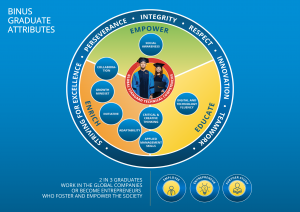
BINUS Graduate Attributes (BGA) is a set of required qualities or skills that BINUS University graduates are expected to develop during their studies. These attributes are cultivated through the process of Educating, Enriching, and Empowering, preparing students for their future paths.
Why should BINUS University students develop BGA?
BGA consists of one technical skill (hard skill) and eight non-technical skills (soft skills), which are developed based on the competencies required for students to pursue their future careers. Therefore, all students need to develop BGA to optimally prepare themselves for their chosen career paths.
Some of the potential career paths for graduates include becoming an employee, entrepreneur, or continuing with further studies. BGA is designed to equip students with competitiveness and strengths that support the achievement of their future careers.
What attributes are developed in BGA during a student’s studies at BINUS University?
There are nine (9) attributes or skills developed within BGA: Global Standard Technical Competencies, Adaptability, Applied Management Skills, Collaboration, Critical & Creative Thinking, Digital & Technology Fluency, Growth Mindset, Initiative, and Social Awareness.
The development of these attributes is grounded in Binusian Values (S-P-I-R-I-T) to strengthen the character of BINUS University students.
Below are the BGA attributes:
1. Global Standard Technical Competencies (GSTC)

The ability to fulfill or accomplish all courses in the curriculum with integrity. This competency enables Binusians to meet the standard technical requirements of their respective study programs.
2. Adaptability
The ability to perform appropriate cognitive, behavioral, and affective responses to uncertain and novel situations. Binusians are expected to adapt, participate, manage, and optimize their roles within group settings and maintain interpersonal relationships during the learning process.
3. Applied Management Skills (AMS)

The practical ability to build effective communication and demonstrate excellent performance through structured and systematic planning and organizing. Binusians are expected to apply effective communication and planning management skills throughout the learning process.
4. Collaboration

The ability to explore differing perspectives on an issue and collectively find solutions. Binusians are expected to build collaboration to support their learning process.
5. Critical & Creative Thinking (CCT)
The ability to produce, evaluate, and analyze information; explain concepts and ideas; explore possibilities; reflect; consider alternative solutions; and solve problems. Binusians are expected to identify, build, and evaluate arguments based on available information, and use their knowledge to construct systematic ideas in response to issues encountered during learning.
6. Digital & Technology Fluency (DTF)
The ability to interpret information and communicate ideas effectively and ethically in a digitally connected world, as well as use relevant technology to construct meaning and create solutions. Binusians are expected to utilize appropriate information and communication technology to support their learning process.
7. Growth Mindset
The belief that personal qualities can be developed through effort, strategies, and support from others (Dweck, 2017). Binusians are expected to apply a growth mindset to support their learning process.
8. Initiative

A behavior characterized by self-starting, proactiveness, and persistence in overcoming barriers and setbacks. Binusians are expected to demonstrate initiative to overcome obstacles and optimize their learning process.
9. Social Awareness
The ability to empathize with individuals from diverse backgrounds and cultures, understand social and ethical norms, and identify community resources and support systems. Binusians are expected to analyze issues in the community and actively participate in addressing them.